
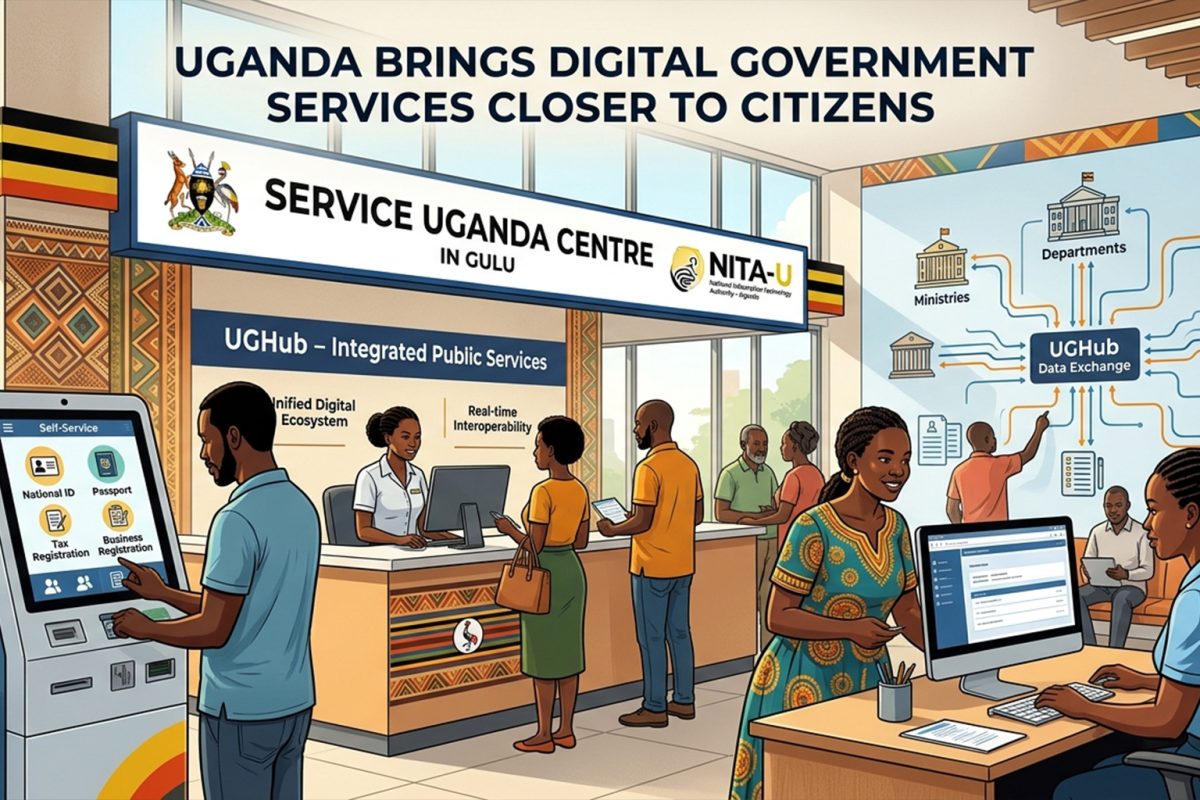
The Government of Uganda is accelerating the implementation of its digital public infrastructure (DPI) through the rollout of integrated service delivery hubs designed to bring government platforms closer to citizens.
The initiative, led by the National Information Technology Authority – Uganda, has entered a new phase with the launch of Service Uganda Centres (SUCs)—physical, technology-enabled facilities that provide access to a wide range of digital government services through a single interface.
The first centre, launched in Gulu in March 2026, forms part of a broader national programme under the Uganda Digital Acceleration Project (UDAP-GovNet), which is supported by the World Bank and aims to strengthen connectivity, interoperability and service delivery across government.
At the core of the initiative is UGHub, Uganda’s national data integration platform, which enables real-time interoperability between ministries, departments and agencies. Through this platform, the Service Uganda Centres allow citizens to access services such as national ID verification, tax registration, passport applications and business registration within a unified digital ecosystem.
Speaking at the launch, Dr Hatwib Mugasa, Executive Director of NITA-U, emphasised the importance of combining digital infrastructure with accessible delivery channels.
“These Centres are a major advancement in bringing government services closer to the people,” he said. “By consolidating multiple services under one roof, we are significantly reducing the cost and time citizens spend accessing public services.”
The rollout reflects Uganda’s wider strategy to build shared digital public infrastructure layers, including identity, data exchange, cybersecurity and service delivery platforms, rather than maintaining fragmented systems across government institutions.
In parallel, NITA-U has also introduced new digital platforms such as UG Support, a centralised IT service management system designed to improve the performance and reliability of government digital services. The platform enhances incident management, authentication and service tracking, strengthening the operational backbone required to support national DPI at scale.
From a policy perspective, the programme is coordinated by the Ministry of ICT and National Guidance, which is overseeing the country’s transition towards a more integrated and data-driven public sector.
Officials involved in the programme have highlighted that interoperability is central to the next phase of digital government. The ongoing renewal of Uganda’s Government Enterprise Architecture and interoperability framework is intended to ensure that systems “collaborate together and not grow in isolation,” supporting a more coherent national digital ecosystem.
The Service Uganda Centres are being delivered through a multi-stakeholder model involving government agencies and public infrastructure partners, including Posta Uganda, which is providing physical infrastructure for the rollout.
As Uganda continues to expand its national backbone infrastructure and integrated platforms, the SUC programme represents a practical step in translating digital public infrastructure into on-the-ground service delivery.
By combining interoperable systems, shared platforms and citizen access points, the initiative demonstrates how DPI can move beyond strategy into implementation—supporting more efficient, inclusive and accessible public services across the country.