
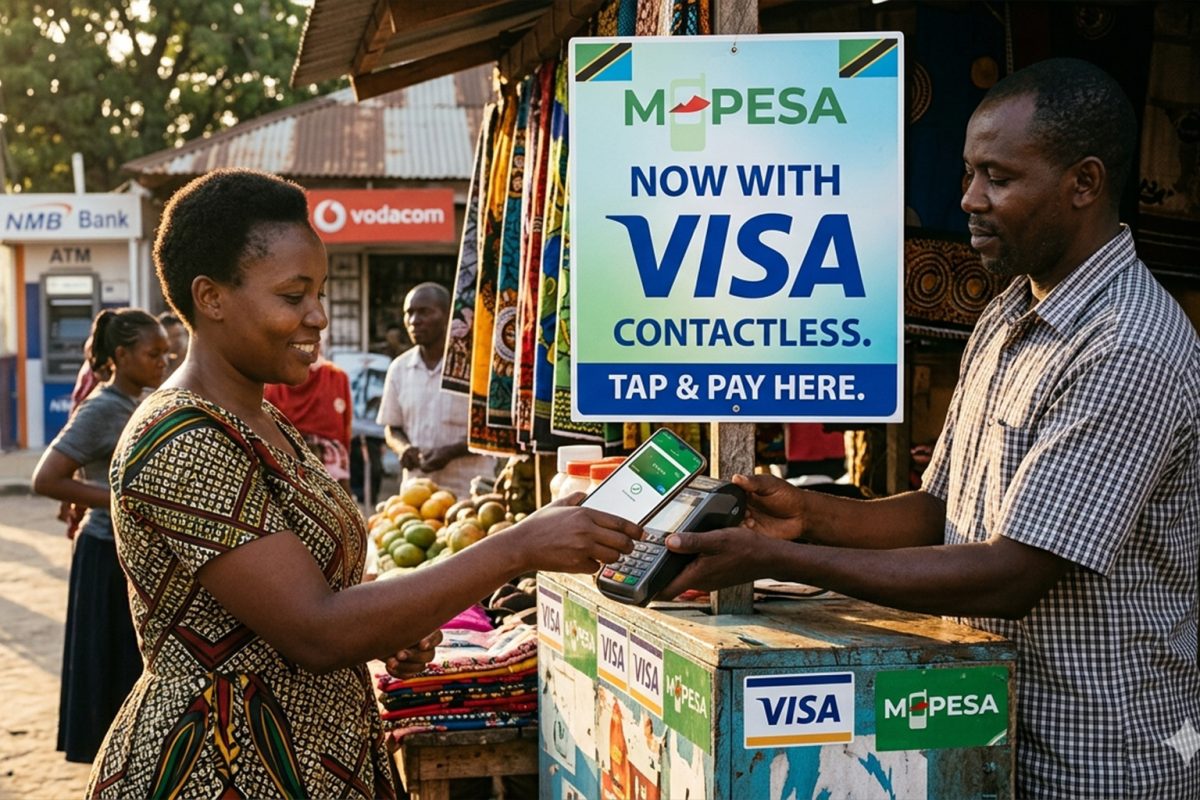
Tanzania has taken a significant step forward in its digital payments evolution with the rollout of a new contactless mobile money feature, marking a convergence of telecommunications infrastructure, fintech innovation, and global payment networks.
The new system enables users of the M-Pesa platform to make tap-to-pay transactions directly from their mobile phones at any compatible point-of-sale terminal. The functionality integrates mobile wallets with global card infrastructure, allowing consumers to complete payments both domestically and internationally without the need for a physical card.
The initiative is supported by Visa and powered through a cloud-based issuing and processing platform, reflecting growing investment in Africa’s digital financial backbone. Industry stakeholders say the innovation represents a shift toward seamless, interoperable payment ecosystems across the continent.
According to sector data, Tanzania’s mobile money market continues to expand rapidly, with tens of millions of active accounts and increasing reliance on digital transactions in everyday commerce.
The introduction of contactless capability is expected to further accelerate adoption, particularly among urban consumers and small businesses seeking faster, more secure payment methods.
Speaking about broader industry developments, Visa representatives have emphasized the importance of strengthening both infrastructure and expertise. “Mastering processes, data, and operational best practices is a key lever to improve performance, security, and customer experience,” said Kossi Akakpo, a senior consultant at Visa.
The Tanzanian government has increasingly prioritized digital payments as part of its national financial inclusion agenda, viewing mobile-based systems as critical to expanding access to formal financial services. Analysts note that interoperability between mobile money and global payment networks is essential for unlocking cross-border commerce and reducing reliance on cash.
At the same time, the rollout underscores the growing role of cloud-based infrastructure in supporting modern payment systems. By enabling tokenized, secure transactions, the platform aims to reduce fraud risks while improving transaction efficiency.
Experts say Tanzania’s approach reflects a broader continental trend, where governments and private-sector partners are investing in digital public infrastructure to support economic growth. The integration of mobile money with global payment rails is increasingly seen as a cornerstone of Africa’s digital economy.
As adoption grows, the success of such initiatives will depend on maintaining system reliability, strengthening cybersecurity protections, and ensuring accessibility for underserved populations. For Tanzania, the latest development signals continued momentum toward a more connected and cashless financial ecosystem.