
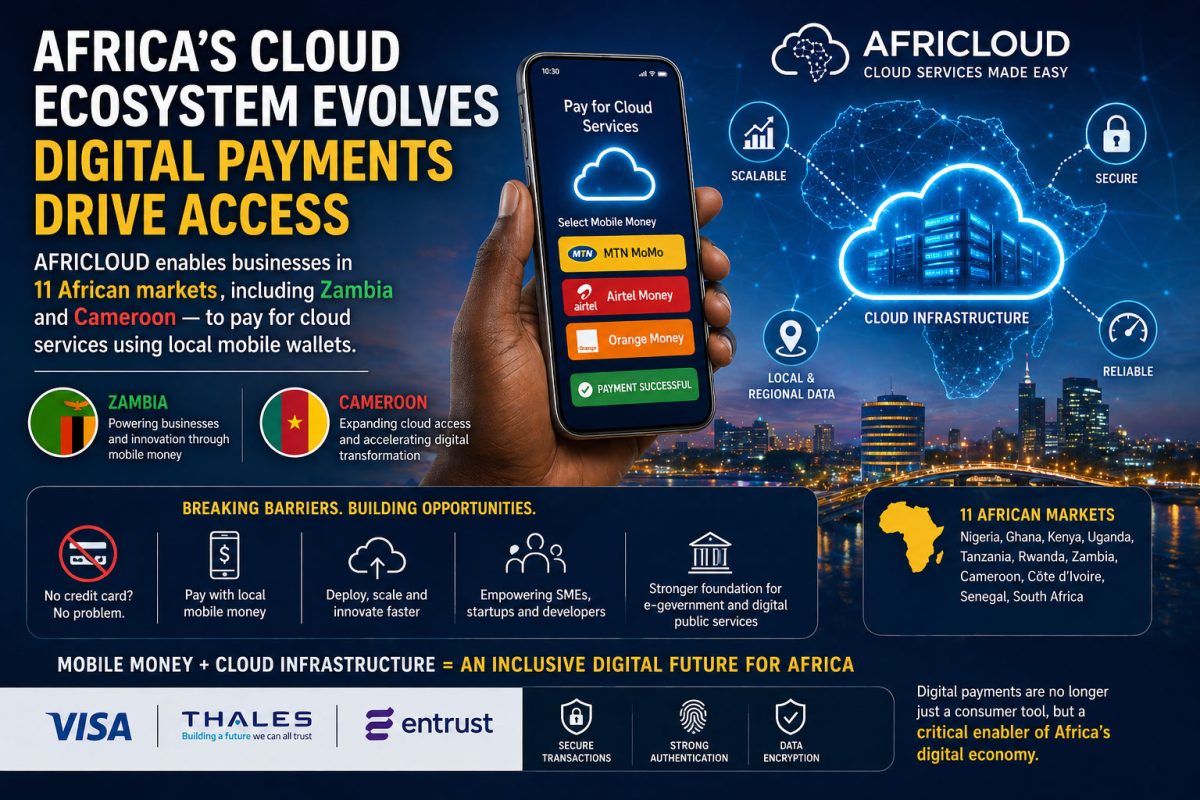
A new development in Africa’s cloud ecosystem is highlighting how digital payments are reshaping access to critical infrastructure, with Zambia and Cameroon among the countries benefiting from expanded mobile money integration.
Cloud provider AFRICLOUD announced this week that businesses in 11 African markets, including Zambia and Cameroon, can now pay for cloud services directly via mobile wallets such as MTN MoMo, Airtel Money, and Orange Money. The move is designed to remove longstanding barriers that have limited access to cloud infrastructure for small and medium-sized enterprises (SMEs).
Traditionally, African businesses seeking cloud services have faced challenges due to limited access to international payment methods like credit cards or cross-border bank transfers. By enabling local currency payments through widely used mobile money platforms, AFRICLOUD is effectively bridging the gap between digital payments and cloud adoption.
“Every technical problem our customers solve on our infrastructure is downstream of one non-technical problem: can they pay us,” said founder Oluniyi Ajao. “For a large part of our market, the answer used to be ‘not easily’. Mobile Money changes that across these 11 countries.”
The shift underscores the growing importance of integrating digital payments with national backbone infrastructure. In countries like Zambia, where mobile money penetration significantly exceeds traditional banking access, enabling local payment methods is seen as critical to unlocking broader digital transformation.
Analysts say the development could accelerate adoption of e-government cloud services, digital entrepreneurship, and data-driven innovation. With easier access to cloud platforms, businesses can deploy applications, store data locally or regionally, and scale operations without the need for complex financial arrangements.
The initiative also reflects a wider trend across Africa, where digital payments are increasingly becoming the foundation for other digital services, including identity systems and public sector platforms. By linking payment rails directly to infrastructure services, providers are creating more inclusive digital ecosystems.
Global technology companies such as Visa, Thales, and Entrust are playing a complementary role in this evolution, supporting secure transactions, authentication, and encryption across digital platforms. For governments in Zambia, Cameroon, and beyond, the implications are significant. Expanding access to cloud infrastructure not only supports private sector growth but also strengthens the foundation for digital public services, from e-government portals to national data systems.
As mobile money continues to dominate Africa’s financial landscape, its integration into cloud and infrastructure services signals a broader shift: digital payments are no longer just a consumer tool, but a critical enabler of the continent’s digital economy.